
How Do Rodent Control Services Conduct a Comprehensive Attic Inspection?
An attic can appear quiet while rodents move through it after dark. Rats and mice can hide beneath insulation, build nests in secluded spaces, and enter through small openings around the roof, vents, walls, and utility lines.
That is why a professional inspection involves much more than searching for a few droppings. A rodent control service Pembroke Pines can conduct a systematic attic inspection to identify signs of activity, nesting areas, travel routes, structural damage, and possible entry points.
Understanding this process can help homeowners recognize what a thorough rodent inspection should include and why each step matters.
Why Attic Inspections Matter for Rodent Control
Attics provide many of the conditions rodents look for. They are usually dark, sheltered, and relatively quiet, with limited human activity.
A comprehensive attic inspection helps determine whether rodents are currently using the space, where they may be nesting, how they are entering the property, and what evidence they have left behind.
For a rodent control service in Pembroke Pines, these findings provide important information before control measures are selected. Instead of relying on assumptions, the inspection connects visible evidence with possible sources of the problem.
What Makes Attics Attractive to Rodents?
Rodents naturally seek protected areas where they can rest, nest, and reproduce. An attic can provide shelter from weather and predators while also offering nesting materials.
Insulation can be used to create nests, while beams, wall edges, roof structures, and stored materials can provide protected travel routes.
Food does not necessarily need to be located in the attic. Rodents may enter through one part of a property and travel through wall cavities or structural spaces before reaching the attic.
This is one reason a rodent control service Pembroke Pines may inspect both the attic and exterior portions of a property rather than focusing only on where homeowners first noticed activity.
How Hidden Rodent Activity Can Go Undetected
Rodents can remain hidden for extended periods. Scratching sounds may be heard at night, while droppings or nesting materials can remain underneath insulation or behind structural components.
Some evidence is also easy to miss during a quick inspection. Small gnaw marks, disturbed insulation, faint odors, and narrow travel paths may not be obvious unless the area is examined carefully.
A comprehensive inspection looks at these smaller clues and considers how they relate to one another.
How a Comprehensive Attic Inspection Begins
A detailed inspection generally begins with an overall assessment of the property.
Before examining individual sections of the attic, a rodent control service Pembroke Pines may consider reported symptoms, previous rodent activity, property construction, and possible exterior access points.
This creates a starting point for a more systematic inspection.
Reviewing the Property and Rodent History
Information from the homeowner can provide useful clues.
An inspector may ask when scratching noises began, where sounds were heard, whether droppings have been noticed, and whether rodents were previously treated.
For example, repeated scratching above one room can help identify an area that deserves closer attention. However, the inspection should not stop there because rodents can move between different attic sections.
Previous repairs can also be relevant. If vents, roof edges, soffits, or utility openings were recently repaired, those areas may deserve additional examination.
Checking Exterior Entry Points
Finding how rodents entered the structure is a central part of a comprehensive inspection.
A rodent control service Pembroke Pines may examine the roofline, soffits, fascia, vents, exterior walls, utility penetrations, and other areas where openings can occur.
The objective is to identify conditions that could allow rodents to enter or move between the exterior and attic.
Roof, Eave, and Vent Inspection
Roof edges, eaves, soffits, and attic vents can create potential access points.
Inspectors may check roof-to-wall connections, damaged vent screens, loose materials, gaps around ventilation components, and other openings.
A large hole is not always necessary for rodent entry. Small gaps can become important when they connect directly to sheltered interior areas.
Wall and Utility Penetrations
Pipes, electrical cables, ducts, and other utilities often pass through walls or structural surfaces.
The areas surrounding these penetrations can develop gaps or deteriorated seals. Inspectors examine them for openings and other conditions that could provide access.
These locations can be overlooked because they may sit behind equipment or in areas that are difficult to see from ground level.
What Inspectors Look for Inside the Attic
After checking potential exterior entry points, the inspection moves into the attic itself.
A professional rodent control service Pembroke Pines looks for several categories of evidence instead of relying on one sign. The location, condition, and pattern of these signs can help explain how rodents are using the space.
Identifying Droppings and Urine Evidence
Rodent droppings are among the most recognizable indicators of activity.
Inspectors may find them near walls, beams, insulation edges, nesting areas, or protected travel routes. Their distribution can provide clues about where rodents frequently move.
Urine staining and odors may offer additional evidence, particularly in enclosed or poorly ventilated areas.
However, droppings do not automatically prove that rodents are currently present. Their condition and relationship to other evidence should also be considered.
Finding Nests and Nesting Materials
Rodents often collect soft or shredded materials to build nests.
In an attic, these materials may include insulation, paper, cardboard, fabric, or other materials available around the property.
Nests may be located in corners, underneath insulation, near structural components, or in areas that provide protection from household activity.
The condition of nesting materials can help inspectors understand whether an area may have been used recently or whether the evidence could be older.
Inspecting Insulation for Damage
Insulation can conceal rodent activity and make it difficult to understand the full extent of a problem from a quick visual check.
Inspectors may look for compressed insulation, displaced material, tunnels, nesting areas, fecal contamination, and unusual disturbances.
Rodents may create narrow pathways through insulation as they move around the attic. These disturbed sections can sometimes connect otherwise separate signs of activity.
If contamination is present, the condition of the insulation may also become an important consideration when determining what should happen next.
Looking for Gnaw Marks and Structural Damage
Rodents regularly chew on accessible materials, making gnaw marks another useful inspection clue.
Inspectors may examine wood, plastic, stored materials, insulation components, and other surfaces for evidence of chewing.
Electrical wiring deserves particular attention. If rodents have damaged wiring insulation, the issue may involve more than pest activity and should be documented appropriately.
A rodent control service Pembroke Pines can use the location of gnaw marks along with other evidence to help identify areas that rodents may be using frequently.
How Inspectors Determine Whether Rodent Activity Is Active
An attic can contain evidence from an old infestation even when rodents are no longer present.
For this reason, professionals do not necessarily interpret every dropping, nest, or gnaw mark as proof of current activity.
Instead, they evaluate several signs together and consider their condition, location, and relationship to other evidence.
Fresh Signs vs. Older Signs
The condition of rodent evidence can provide clues about when it may have been produced.
Recently disturbed nesting material, fresh-looking droppings, new gnaw marks, and current odors may indicate more recent activity. Older evidence may appear dry, degraded, dusty, or partially covered.
These observations should be interpreted as part of the overall inspection rather than as an exact timeline.
Tracking Rodent Travel Routes
Rodents often favor protected routes along walls, beams, insulation edges, pipes, ducts, and other structural features.
An inspector may follow these areas to determine whether separate signs of activity are connected.
Think of it like following a trail. One clue may tell you very little, but several clues appearing along the same pathway can reveal how rodents may be moving through the attic.
What Happens After the Attic Inspection?
Once the inspection is complete, the findings can be organized into a clearer picture of the property.
The objective is not simply to confirm that rodents have been present. The inspection should help identify where activity is occurring, how rodents may be accessing the building, and what conditions may allow the problem to continue.
A rodent control service Pembroke Pines can use these findings to determine which areas require attention and what type of control approach may be appropriate.
Creating an Inspection-Based Control Plan
Inspection findings can help shape the next steps.
For example, evidence of active rodents may require measures aimed at the existing population. Identified entry points may require separate attention to reduce opportunities for additional rodents to enter.
The specific approach depends on the findings, property conditions, level of activity, and location of the problem.
This is why inspection should come before assumptions about what treatment a property needs.
Why Entry-Point Identification Matters
Addressing visible rodent activity does not necessarily explain how the animals entered the building.
If an accessible opening remains, rodents may have another opportunity to enter later. Identifying potential entry points therefore helps explain the larger problem.
It is similar to finding water beneath a leaking roof. Cleaning up the water addresses the immediate evidence, but identifying the opening explains how the water got inside.
How Professional Rodent Inspections Differ From a Basic Visual Check
A basic visual check might identify obvious droppings, a visible nest, or a damaged section of insulation.
A comprehensive inspection goes further by considering exterior access points, attic conditions, nesting areas, travel routes, droppings, odors, gnaw marks, insulation damage, and utility penetrations.
A rodent control service Pembroke Pines can use this broader approach to connect separate pieces of evidence rather than treating each sign as an isolated problem.
The value of a comprehensive inspection comes from the process itself. Each observation contributes to a larger understanding of how rodents may be using the structure.
What Homeowners Should Know Before an Attic Inspection
Homeowners can make an inspection more informative by sharing when they first noticed unusual noises, odors, droppings, or other signs.
It is useful to mention where scratching or movement has been heard and whether similar activity has occurred previously.
Homeowners should also mention previous rodent treatments or repairs involving the roof, vents, soffits, walls, or other potential access points.
Attics may contain electrical wiring, insulation, unstable surfaces, and restricted areas. Because of these hazards, homeowners should avoid entering difficult spaces simply to search for rodents themselves.
A professional rodent control service Pembroke Pines can evaluate the attic using a systematic process designed to identify both visible and less obvious evidence.
EntoLogic Pest Solutions Serving the Town Gate Community and Beyond in Pembroke Pines
EntoLogic Pest Solutions is dedicated to serving the diverse needs of the local community of Pembroke Pines, including individuals residing in neighbourhoods like Town Gate. With its convenient location near landmarks such as the Calidad Inspections and major intersections like NW 9th St and NW 170th Terrace (coordinates: 26.013227, -80.3744919), we offer rodent control service services.
Get rodent control service services at Town Gate Now
Call Us or Contact Us: +1 954-955-3031
Navigate from Town Gate to EntoLogic Pest Solutions Now
Rodent Activity in Numbers: What the Data Shows
The statistics behind rodent behaviour explain why a thorough attic inspection looks for small signs:
- Winter invasions: Rodents invade an estimated 21 million U.S. homes each winter as they move indoors for warmth, food, and shelter (National Pest Management Association).
- Entry size: A mouse can pass through an opening of about 6 millimeters — roughly the width of a pencil — so an attic that looks sealed may not be sealed at all.
- Daily evidence: A single mouse can leave 50 to 75 droppings in one day, which is why droppings patterns are such reliable inspection evidence.
- Disease risk: According to the Centers for Disease Control and Prevention (CDC), rodents can spread more than 35 diseases to people, directly through droppings, urine, saliva, and bites, or indirectly through ticks, mites, and fleas.
- Breeding speed: A single pair of mice can produce dozens of offspring within a year, so a small, quiet attic problem can become a large one in a single season.
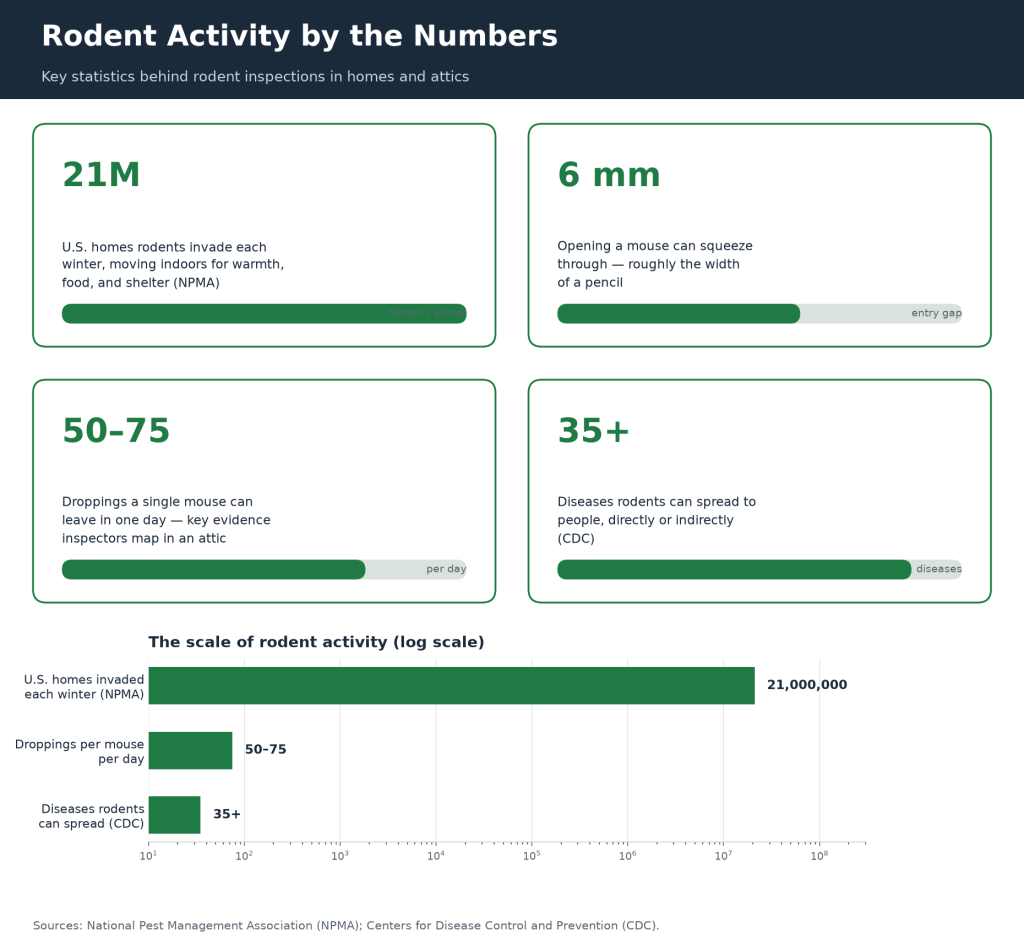
Measured against these numbers, an inspection that maps entry points, droppings, and travel routes is the difference between guessing where rodents are and knowing.
Sources: National Pest Management Association (NPMA), rodent invasion estimates; Centers for Disease Control and Prevention (CDC), “Diseases from Rodents” and rodent control guidance.
A comprehensive attic inspection is essentially an investigation into how rodents may be using a property. It looks beyond obvious droppings to identify nesting areas, travel routes, entry points, insulation damage, gnaw marks, and evidence that may indicate current activity.
The process also connects the attic with the exterior of the building. By examining both areas, a rodent control service Pembroke Pines can develop a more complete understanding of the conditions contributing to rodent activity.
For EntoLogic Pest Solutions, an inspection-based approach provides the information needed to understand the specific conditions of a property rather than treating every attic as if it has the same rodent problem.
Frequently Asked Questions
How long does a rodent attic inspection take?
The time can vary depending on the attic’s size, accessibility, construction, and amount of evidence present. A small, accessible attic may take less time to inspect than a larger space with restricted areas or extensive signs of activity.
What are the most common signs of rodents in an attic?
Common signs include droppings, nesting materials, scratching sounds, disturbed insulation, gnaw marks, unusual odors, urine staining, and visible travel paths.
Finding several signs together can provide more useful information than finding one isolated indicator.
Can rodents enter an attic without leaving obvious damage?
Yes. Rodents may use existing gaps and openings without causing obvious structural damage.
Potential access areas include vents, roof edges, soffits, utility penetrations, wall openings, and damaged exterior materials. This is why a detailed inspection examines both obvious and less noticeable access points.
Does attic insulation need to be replaced after rodent activity?
Not necessarily. The appropriate response depends on the type and extent of contamination and the condition of the insulation.
In some situations, only affected sections may require attention. More extensive contamination can require a broader assessment before deciding whether replacement is appropriate.
How often should an attic be inspected for rodent activity?
There is no single inspection schedule that applies to every property.
An inspection may be appropriate when homeowners notice recurring scratching, new droppings, unusual odors, damaged materials, or visible entry points. Properties with known access vulnerabilities may also require closer monitoring.