
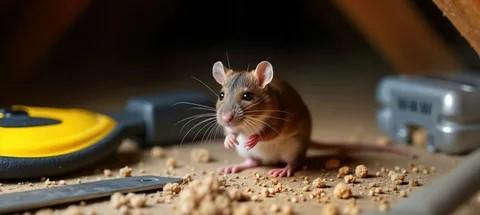
How Does Commercial Rodent Control Find Rodent Entry Points in Buildings?
Rodents rarely need a wide-open door to get inside a commercial building. A small gap around a pipe, an opening beneath a loading-door threshold, or a damaged vent can become an access route. Once inside, rodents may move through wall voids, ceilings, storage areas, kitchens, mechanical rooms, and other concealed spaces.
So, how does commercial rodent control actually figure out where rodents are getting in?
The answer usually involves more than simply looking for a visible hole. A thorough inspection combines structural observation, evidence of rodent activity, knowledge of building construction, and careful tracing of travel routes.
For businesses researching commercial rodent control Pembroke Pines, understanding this inspection process can make it easier to recognize why entry-point identification is such an important part of rodent management. Businesses such as EntoLogic Pest Solutions may use these principles when assessing commercial properties, but the underlying inspection methods apply broadly to warehouses, offices, restaurants, retail buildings, and other structures.
Why Rodent Entry Points Are Difficult to Detect
Rodent access points are often hidden in places people rarely inspect. Commercial buildings can have complicated layouts, multiple utility connections, suspended ceilings, exterior wall penetrations, roof equipment, and loading areas.
A building may appear completely sealed from the outside while still containing several pathways large enough for rodents.
Rodents Use Surprisingly Small Openings
Rodents are capable of squeezing through openings that may appear insignificant during a casual inspection. Their flexible bodies allow them to exploit gaps around pipes, conduits, doors, vents, and deteriorated building materials.
This is why inspectors do not simply look for large holes. A narrow crack can be more important than a large but inaccessible opening if it connects directly with an interior space.
Hidden Building Gaps Create Inspection Challenges
Commercial structures often contain spaces behind walls and above ceilings that are difficult to see. An opening may also be hidden by equipment, stored materials, insulation, vegetation, or architectural features.
Think of the building like a maze. Finding a rodent inside tells you where the animal ended up—not necessarily where it entered.
What Commercial Rodent Inspections Look For
A commercial inspection generally considers both the building and the evidence of rodent activity. The goal is to connect physical openings with signs that rodents are actually using particular areas.
Exterior Building Inspection
The exterior inspection typically starts close to ground level and moves upward.
Inspectors may examine foundation joints, wall penetrations, doors, windows, vents, rooflines, utility entrances, drainage areas, and other structural transitions.
Particular attention is often given to locations where different materials meet. These junctions can deteriorate over time and create gaps that were not present when the building was constructed.
Interior Inspection
Inside the building, inspectors look for signs that indicate where rodents are traveling or nesting.
Storage rooms, kitchens, food-handling areas, mechanical rooms, electrical spaces, ceiling voids, and wall cavities can all provide useful clues.
Utility Penetrations and Service Openings
Pipes, cables, conduits, ducts, and other utilities frequently pass through walls and floors. The openings surrounding these services may not always be completely sealed.
Even when the penetration is difficult to see, signs of rodent movement nearby can draw attention to it.
Doors, Windows, and Loading Areas
Commercial doors deserve particular attention because they are frequently opened and closed throughout the day.
Loading docks, warehouse doors, service entrances, and older door thresholds can develop gaps through normal wear. Damaged weather stripping or uneven surfaces can also leave openings near the floor.
How Rodent Signs Help Reveal Entry Points
Finding an opening is only part of the investigation. Inspectors also need to determine whether rodents are using it.
Droppings and Urine Trails
Droppings can indicate areas of rodent activity, although they do not necessarily identify the original entry point.
A concentration of droppings near a wall, piece of equipment, or concealed passage can help establish a travel route. Odor and staining may provide additional clues in areas where rodents have repeatedly moved.
Gnaw Marks and Structural Damage
Rodents constantly gnaw because their incisors continue growing throughout their lives.
Chewed packaging, wood, insulation, plastic, and other materials can therefore provide evidence of activity. Fresh-looking damage near a structural opening may be especially useful when determining how rodents are moving through a building.
Grease Marks and Rub Trails
Rodents often travel along walls and other protected edges. Repeated movement can leave dark, greasy marks where their bodies repeatedly contact surfaces.
These rub marks can help inspectors trace movement toward concealed gaps or potential entry points.
Common Rodent Entry Points in Commercial Buildings
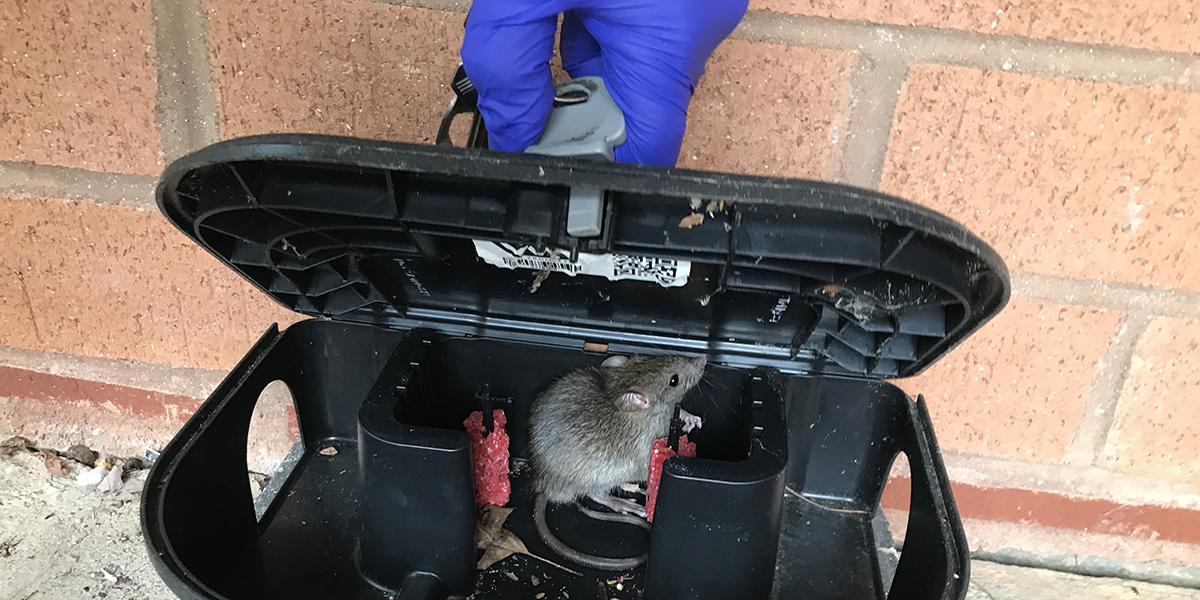
Although every building is different, certain locations repeatedly deserve attention during a rodent inspection.
Rooflines, Vents, and Wall Openings
Rodents are not limited to ground-level access.
Roof penetrations, ventilation openings, damaged flashing, gaps around rooftop equipment, and deteriorated exterior materials can create pathways into upper portions of a building.
Foundation Gaps and Ground-Level Openings
At ground level, inspectors may examine cracks, expansion joints, foundation transitions, damaged masonry, and gaps around exterior equipment.
Vegetation, debris, or stored materials can make these areas harder to inspect and may also conceal openings.
Plumbing, Electrical, and HVAC Openings
Commercial buildings require numerous utility connections. Every penetration through a wall, ceiling, or floor represents a location worth evaluating.
The issue is not necessarily the pipe, cable, or duct itself. The vulnerability may be the surrounding gap where that service passes through the structure.
Tools Used to Locate Rodent Entry Points
Professional inspections can involve relatively simple tools as well as specialized monitoring equipment.
Flashlights, Inspection Mirrors, and Cameras
A strong flashlight can reveal cracks and damage that are difficult to see under normal lighting.
Inspection mirrors can help examine tight spaces, while cameras may provide visibility inside concealed areas without immediately opening walls or other building components.
Tracking Materials and Monitoring Devices
When physical evidence is unclear, monitoring can help determine whether rodents are actively using a suspected route.
Tracking methods can reveal movement patterns and help distinguish an active pathway from an opening that simply happens to exist.
How Professionals Trace Rodent Movement
Finding the entry point often requires connecting several pieces of evidence rather than relying on one clue.
Following Travel Routes
Rodents frequently favor protected routes along walls, behind equipment, beneath shelving, and through concealed spaces.
If signs of activity form a consistent path, inspectors can work backward toward areas where that path may connect with the exterior.
Separating Entry Points From Interior Hiding Areas
A rodent may spend most of its time in one part of a building while entering somewhere completely different.
For example, a rodent could enter near a loading dock and eventually reach a food-storage area through a wall void. The place where the animal is discovered is therefore not automatically the place where it entered.
Why Multiple Entry Points Are Common
Commercial buildings can have dozens of potential access locations. Repairs, renovations, utility installations, weather damage, and normal deterioration can create new gaps over time.
That means discovering one opening does not necessarily prove it is the only route.
A comprehensive inspection considers the entire building envelope rather than stopping after finding the first obvious gap.
What Happens After Entry Points Are Found?
Once potential access points have been identified, they can be evaluated according to their location, condition, size, and relationship to observed rodent activity.
Prioritizing Structural Vulnerabilities
Not every gap presents the same level of concern. An opening directly connected to an interior wall cavity may require more attention than an isolated exterior defect with no practical pathway inside.
The surrounding conditions matter, too. Food sources, shelter, moisture, waste areas, and building traffic can influence how attractive a particular route may be to rodents.
Monitoring After Exclusion
Inspection does not necessarily end once a suspected opening has been addressed.
Monitoring can help determine whether rodent activity decreases and whether additional access points remain. If signs continue, the inspection process may need to expand to other parts of the structure.
How Commercial Rodent Control Pembroke Pines Applies These Methods
When researching commercial rodent control Pembroke Pines, it helps to understand that effective rodent inspection is fundamentally a building-detection process.
Local commercial properties can have different construction styles, maintenance histories, drainage conditions, utility layouts, and exterior environments. Rather than assuming every property has the same vulnerability, an inspection should examine the individual structure.
EntoLogic Pest Solutions is a business name that may appear in searches for commercial pest-related services in the area, but the principles behind identifying rodent entry points are broader than any individual company. The important concepts are systematic inspection, evidence-based tracing, identification of structural vulnerabilities, and continued monitoring.
EntoLogic Pest Solutions Serving the SilverLakes Community and Beyond in Pembroke Pines
EntoLogic Pest Solutions is dedicated to serving the diverse needs of the local community of Pembroke Pines, including individuals residing in neighbourhoods like SilverLakes. With its convenient location near landmarks such as the Chevron and major intersections like NW 172nd Ave and Pines Blvd (coordinates: 26.008727, -80.3769956), we offer commercial rodent control services.
Get commercial rodent control services at SilverLakes Now
Call Us or Contact Us: +1 954-955-3031
Navigate from SilverLakes to EntoLogic Pest Solutions Now
Commercial Rodent Risk in Numbers: What the Data Shows
The statistics behind rodent enforcement explain why entry-point control matters so much in commercial buildings:
- Entry size: A mouse can pass through an opening of about 6 millimeters — roughly the width of a pencil — so a building that looks sealed may not be sealed at all.
- Daily evidence: A single mouse can leave 50 to 75 droppings in one day, and every dropping found during an inspection is recorded as evidence of active rodent presence.
- Disease risk: According to the Centers for Disease Control and Prevention (CDC), rodents can spread more than 35 diseases to people, including salmonellosis and leptospirosis, both linked to contaminated food, water, and surfaces.
- Food losses: Widely cited global estimates attribute the contamination or destruction of around 20 percent of the world’s food supply every year to rodents, through feeding, urine and droppings, and spoilage of stored goods.
- Regulatory standard: The FDA Food Code treats pest control as a standing requirement — food establishments must keep their premises free of insects, rodents, and other pests, and maintain the building so pests cannot enter in the first place.
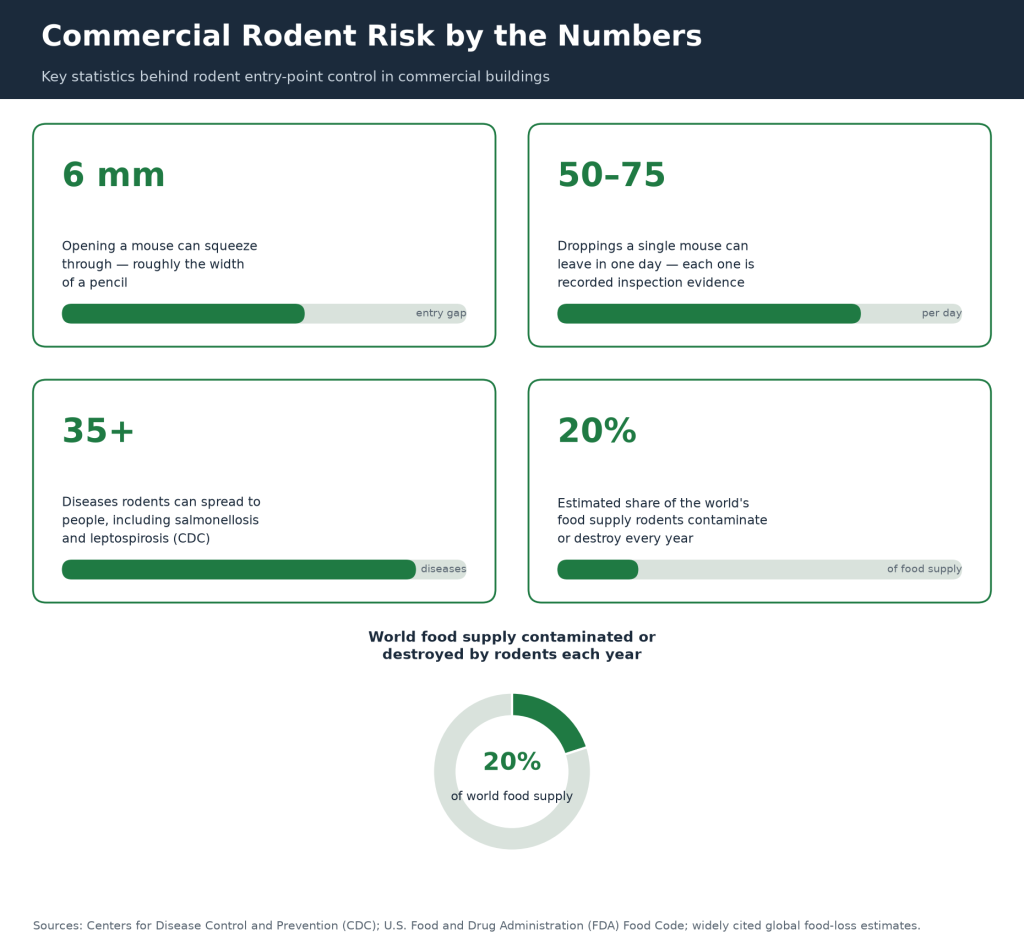
Measured against these numbers, finding and sealing entry points is not a finishing touch. It is the control measure every other step depends on.
Sources: Centers for Disease Control and Prevention (CDC), “Diseases from Rodents” and rodent control guidance; U.S. Food and Drug Administration (FDA), Food Code, provisions on controlling pests in food establishments; widely cited global estimates of rodent-related food supply losses.
Finding where rodents enter a commercial building is more like solving a puzzle than simply searching for a hole. Inspectors look at the structure from the outside and inside, study droppings and damage, trace travel patterns, examine utility penetrations, and consider concealed pathways. Because rodents can exploit surprisingly small openings, even minor structural gaps deserve attention when they connect to interior spaces.
Understanding this process also explains why finding a rodent does not automatically reveal how it entered. The visible animal is only one piece of the puzzle; the building itself often provides the rest of the clues.
FAQs About Finding Rodent Entry Points
How small can a rodent entry point be?
Rodents can use surprisingly small openings, particularly where flexible building materials or poorly sealed penetrations create narrow gaps. The exact opening size depends on the rodent species and the shape and flexibility of the gap.
Where do rodents usually enter commercial buildings?
Common locations include gaps beneath doors, loading dock areas, foundation openings, damaged vents, roof penetrations, utility penetrations, and deteriorated sections of exterior walls.
Can rodents enter through plumbing openings?
Yes. The pipe itself generally is not the access route. Instead, rodents may use an unsealed gap surrounding a pipe where it passes through a wall, floor, or other structural surface.
How do inspectors know which opening rodents are using?
They compare physical openings with evidence such as droppings, rub marks, gnawing, nesting material, odors, and observed travel patterns. Monitoring can provide additional information when the active route is uncertain.
Does finding one entry point mean there are no others?
No. Commercial buildings may have several independent vulnerabilities. Finding one active entry point is useful, but a broader inspection can help identify additional openings that could provide future access.