

How Does a Rodent Control Service Identify Hidden Entry Points Around a Property?
Rodents are surprisingly skilled at finding ways into homes and commercial buildings. A mouse can squeeze through an opening as small as a dime, while rats can enter through gaps that many property owners would never notice. Because of this, identifying hidden entry points is one of the most important parts of any rodent management strategy.
A professional rodent control service pembroke pines focuses heavily on locating these concealed access points before addressing the infestation itself. Understanding how experts find these openings can help property owners better protect their buildings and reduce the risk of future rodent activity.
In this article, we’ll explore the inspection process, the areas professionals examine, the signs they look for, and the methods used to uncover hidden entry points around a property.
Why Do Rodents Need Entry Points?
Rodents enter buildings for three primary reasons: food, water, and shelter. Once they discover a reliable source of any of these necessities, they will actively search for ways to gain access.
Unlike larger pests, rodents do not require large openings. Their flexible bodies allow them to compress and squeeze through surprisingly small gaps. This ability makes hidden entry points particularly difficult for property owners to identify.
A successful inspection begins with understanding rodent behavior. Professionals know that rodents rarely enter randomly; they typically follow established pathways that provide safety and easy access to resources.
Why Hidden Entry Points Often Go Unnoticed?
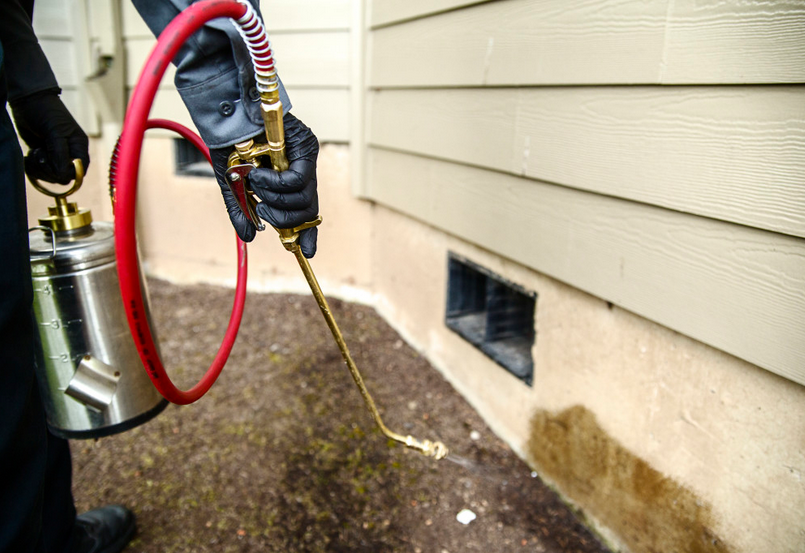
Many entry points are located in places people rarely inspect. These areas may be behind appliances, inside attics, beneath decks, or around utility penetrations.
The Difference Between Visible and Hidden Access Areas
Visible openings are easy to identify because they are exposed and accessible. Hidden entry points, however, may be concealed behind landscaping, construction materials, insulation, or stored items.
A tiny gap hidden behind a water heater may be just as significant as a larger opening near a garage door.
Common Property Features That Conceal Gaps
Several building components can hide rodent access points:
- Decorative siding
- Roof overhangs
- Utility boxes
- Foundation landscaping
- Storage sheds
- Air conditioning units
- Attic vents
These areas often create shadows and obstructions that make inspection more challenging. There should be termite Control services that can remove the termite completely.
The Initial Property Inspection Process
A thorough inspection is the foundation of effective rodent control. Professionals typically begin with a complete assessment of both the exterior and interior of the property.
Exterior Assessment Techniques
The exterior inspection often starts at the foundation and progresses upward around the entire structure.
Inspectors carefully examine:
- Foundation cracks
- Utility penetrations
- Vent openings
- Roof edges
- Chimneys
- Door thresholds
- Window frames
They are not simply looking for holes. They are looking for evidence that rodents are actively using these areas.
Interior Assessment Techniques
Inside the building, professionals inspect locations where rodent activity is most likely to occur.
Common inspection areas include:
- Attics
- Crawl spaces
- Utility rooms
- Kitchens
- Storage areas
- Wall voids
- Ceiling spaces
These inspections help determine whether rodents are already inside and where they may be entering.
Areas Rodent Control Professionals Examine Closely
Some parts of a property are far more vulnerable than others.
Rooflines and Attic Spaces
Rooflines are often overlooked by property owners. However, damaged soffits, loose fascia boards, and deteriorated vents frequently provide access points.
Rodents are excellent climbers. Rats can travel along utility lines, tree branches, and fences to reach elevated openings.
Attics offer warmth, protection, and nesting opportunities, making them highly attractive.
Foundation Cracks and Expansion Joints
Foundation gaps often develop naturally as buildings settle over time.
Small cracks can become larger due to moisture fluctuations, temperature changes, and structural movement.
Professionals inspect:
- Expansion joints
- Concrete cracks
- Gaps beneath siding
- Areas where walls meet foundations
These locations are common entry routes for mice.
Utility and Plumbing Penetrations
Whenever pipes, wires, or cables pass through walls, small openings often remain around them.
These gaps may seem insignificant to humans but can easily accommodate rodents.
Inspectors pay special attention to:
- Plumbing lines
- Electrical conduits
- Internet cables
- Gas lines
- HVAC connections
These locations frequently serve as hidden access points.
Doors, Windows, and Garage Openings
Even modern buildings can develop gaps around doors and windows.
Weather stripping deteriorates over time, creating openings large enough for rodents.
Garage doors are especially vulnerable because uneven concrete surfaces often create small spaces beneath the door.
Signs That Reveal Hidden Entry Points
Finding an opening is easier when professionals know what clues to look for.
Rodent Droppings and Grease Marks
Rodents tend to follow the same routes repeatedly.
As they travel, they leave behind droppings and oily residue from their fur. These grease marks often appear along walls and near entry points.
The concentration of these signs helps professionals trace movement patterns.
Gnawing Damage and Rub Marks
Rodents constantly gnaw to maintain their teeth.
Inspectors often discover:
- Chewed wood
- Damaged insulation
- Gnawed plastic
- Wire damage
These indicators frequently point toward active entry locations.
Unusual Sounds and Odors
Scratching sounds inside walls or ceilings may indicate rodent movement between nesting areas and entry points.
Musty odors can also signal hidden activity.
While sounds and smells alone do not identify an opening, they help narrow the search area.
Specialized Tools Used to Locate Entry Points
Professional inspections often involve tools that improve visibility and accuracy.
Flashlights and Inspection Cameras
High-powered flashlights help reveal small gaps and signs of rodent activity.
Inspection cameras allow professionals to examine:
- Wall cavities
- Crawl spaces
- Tight utility areas
- Ceiling voids
These tools help uncover locations that cannot be seen directly.
Moisture and Structural Assessment Tools
Moisture issues often contribute to structural deterioration.
Professionals may use specialized devices to identify:
- Water-damaged materials
- Structural weaknesses
- Areas vulnerable to future rodent access
By understanding the building’s condition, inspectors can predict where new openings may develop.
How Seasonal Changes Affect Rodent Entry Activity
Rodent behavior changes throughout the year.
Entry Risks During Rainy Seasons
Heavy rainfall can flood outdoor burrows and force rodents to seek shelter indoors.
As a result, rodents become more aggressive in searching for access points around buildings.
Properties with drainage issues often experience increased activity during wet periods.
Cold Weather Rodent Movement Patterns
When temperatures drop, rodents look for warm nesting locations.
Attics, wall cavities, and utility rooms become attractive shelter options.
Professional inspectors understand these seasonal patterns and focus on vulnerable areas accordingly.
Why Landscaping Can Influence Rodent Access
The area surrounding a structure can significantly impact rodent activity.
Trees and Shrubs as Access Routes
Overgrown vegetation can create natural bridges to buildings.
Rodents may use:
- Tree branches
- Climbing vines
- Dense shrubs
- Fence lines
These pathways allow access to roofs and upper-level openings.
Ground Cover and Outdoor Storage Areas
Mulch, stacked firewood, and outdoor storage can provide excellent hiding places.
These environments allow rodents to remain concealed while approaching a structure.
Reducing clutter around buildings often decreases opportunities for hidden entry.
The Importance of Mapping Rodent Movement
Professional inspections do more than locate holes.
Experts analyze movement patterns to determine:
- Where rodents are entering
- How often they travel
- Which routes they prefer
- Where nesting sites may exist
This process helps create a complete picture of the infestation.
Companies such as EntoLogic Pest Solutions emphasize the importance of understanding rodent behavior because entry points alone rarely tell the entire story.
Tracking movement patterns often reveals additional vulnerabilities that might otherwise remain hidden.
Preventive Measures After Entry Points Are Found
Finding an opening is only the beginning.
Sealing Structural Openings
After identifying access points, professionals evaluate appropriate exclusion methods.
Common exclusion materials include:
- Metal flashing
- Hardware cloth
- Steel mesh
- Concrete repair materials
- Durable sealants
The goal is to prevent re-entry while maintaining structural integrity.
Ongoing Monitoring Practices
Even after openings are addressed, monitoring remains important.
Periodic inspections help detect:
- New structural damage
- Emerging gaps
- Seasonal vulnerabilities
- Changes in rodent activity
Ongoing observation reduces the likelihood of future infestations.
The Role of Professional Experience in Detection
Experience often makes the difference between finding obvious openings and uncovering hidden vulnerabilities.
Trained professionals understand how rodents behave, where they travel, and what conditions attract them.
An experienced inspector can often identify subtle warning signs that an untrained observer might miss entirely.
This expertise is especially valuable because rodents continuously adapt to changes in their environment. What appears secure today may become vulnerable tomorrow.
For this reason, a thorough rodent control service in pembroke pines inspection focuses on both current entry points and potential future risks.
EntoLogic Pest Solutions Serving the SilverLakes Community and Beyond in Pembroke Pines
EntoLogic Pest Solutions is dedicated to serving the diverse needs of the local community of Pembroke Pines, including individuals residing in neighbourhoods like SilverLakes. With its convenient location near landmarks such as the Honda Lake and major intersections like SW 1st Ct and SW 166th Ave (coordinates: 26.0057129, -80.370103), we offer rodent control service services.
Get rodent control service services at SilverLakes Now
Call Us or Contact Us: +1 954-955-3031
Navigate from SilverLakes to EntoLogic Pest Solutions Now
Identifying hidden rodent entry points requires far more than a quick visual inspection. Professionals carefully examine foundations, rooflines, utility penetrations, doors, windows, attics, crawl spaces, and landscaping features to uncover the small openings rodents use to access buildings.
By combining detailed inspections, behavioral analysis, physical evidence, and specialized tools, experts can locate vulnerabilities that would otherwise remain unnoticed. Understanding how these inspections work helps property owners appreciate the complexity of rodent management and the importance of proactive prevention.
Whether the issue involves mice, rats, or other rodent species, locating and addressing hidden entry points remains one of the most effective ways to reduce long-term activity and protect a property’s structure.
How Does a Rodent Control Service Identify Hidden Entry Points Around a Property?
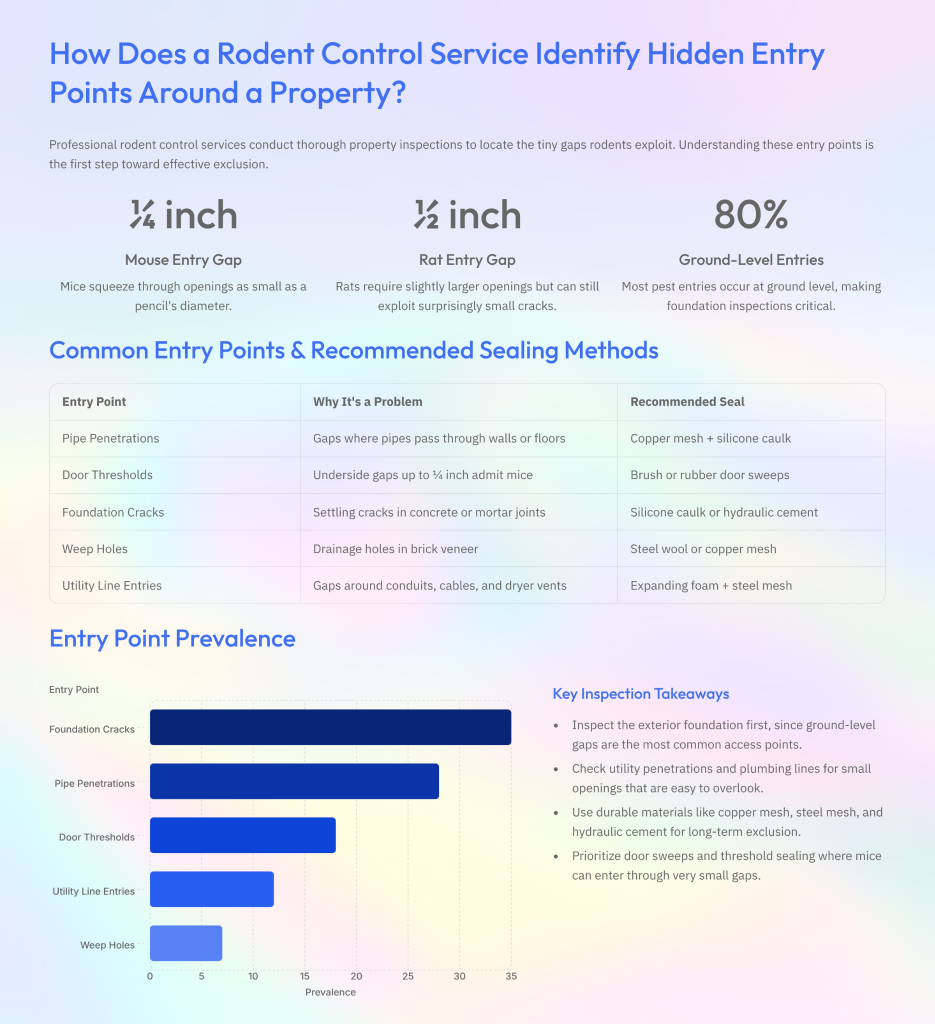
The Tiny Gaps Rodents Exploit: A Visual Guide
- The Pencil Test: Mice can squeeze through gaps as small as ¼ inch (the diameter of a pencil). Rats need slightly more, around ½ inch.
- Source: Illustrated Guide to House Mouse Exclusion and Monitoring; Rodent-Proof Construction — Structural
- Ground Level Dominance: Approximately 80% of pest entries occur at ground level.
- Source: Every Way Pests Enter Your Home: The Complete Entry Point
- Common Entry Points & Their Size:
- Gaps around pipe penetrations: Seal with copper mesh packed tight, sealed over with silicone caulk.
- Exterior door thresholds: Gaps under doors can be as large as ¼ inch, admitting mice. Seal with brush or rubber door sweeps.
- Foundation cracks: Settling cracks in concrete or mortar joints are entry points. Seal with silicone caulk or hydraulic cement.
- Weep holes in brick veneer: These drainage holes can be entry points for mice, wasps, and cockroaches. Seal with steel wool or copper mesh.
- Utility line entry points: Seal gaps around electrical conduits, cable lines, and dryer vents.
Source: Every Way Pests Enter Your Home: The Complete Entry Point; Rodent Control in Dallas Local Rates, Zones & Reviews
Frequently Asked Questions
1. How small of an opening can a mouse use to enter a building?
A mouse can often squeeze through an opening as small as a dime, making tiny cracks and gaps potential entry points.
2. Why are utility penetrations common rodent entry locations?
Pipes, cables, and conduits often leave small spaces around them that provide easy access into walls and buildings.
3. Can rodents enter through roof vents?
Yes. Damaged or improperly screened roof vents can provide access to attics and upper sections of a structure.
4. How often should a property be inspected for rodent entry points?
Many professionals recommend periodic inspections throughout the year, especially after storms, renovations, or seasonal weather changes.
5. Does landscaping affect rodent activity around a property?
Yes. Dense vegetation, overgrown trees, mulch, and outdoor storage areas can create shelter and travel routes that increase the likelihood of rodent access.