

How Does Professional Pest Control Keep Your Home Pest-Free?
Keeping pests out of a home is not simply a matter of removing the insects or rodents you can see. A lasting solution usually requires understanding why pests entered, where they are hiding, what attracts them, and how they reproduce.
This is where professional pest control becomes more systematic. For example, Professional pest control Pembroke Pines involves more than applying a treatment to an obvious problem area. A professional approach can combine inspection, pest identification, targeted treatment, prevention, monitoring, and environmental changes.
But how does that process actually work? Let’s break it down.
What Does Professional Pest Control Actually Do?
Professional pest control is designed to address both an existing infestation and the conditions that allow pests to survive.
Rather than focusing only on visible insects, technicians look at the bigger picture. They consider moisture, food sources, shelter, structural gaps, landscaping, and pest behavior.
The goal is to interrupt the conditions pests need to thrive.
Finding Where Pests Are Hiding
Many pests spend much of their time out of sight. Cockroaches may hide behind appliances, ants can travel through wall voids, and rodents may remain inside attics or concealed spaces.
A professional inspection helps locate these hidden activity areas instead of treating only the places where pests happen to appear.
Identifying the Pest and Its Behavior
Different pests require different approaches.
An ant colony, termite infestation, cockroach problem, and rodent issue do not behave the same way. Correct identification helps determine where to look, what conditions matter, and which control methods are appropriate.
Misidentifying a pest can lead to an ineffective treatment because you’re essentially trying to solve the wrong problem.
How Professionals Inspect a Home for Pest Problems

Inspection is often the foundation of an effective pest management plan. It provides information about the size, location, and possible source of an infestation.
A technician may examine both indoor and outdoor areas because pests rarely respect the boundaries between them.
Checking Common Pest Entry Points
Small openings can become highways for unwanted visitors. Cracks, gaps, vents, doors, windows, and utility penetrations can provide access into a building.
Doors, Windows, and Utility Openings
Gaps around doors and windows can allow insects and rodents to enter. Openings around pipes, cables, and other utilities can create additional pathways.
Even a narrow crack can matter when a pest is small enough to squeeze through it.
Rooflines, Vents, and Exterior Gaps
Some pests enter from above rather than at ground level. Roof edges, vents, soffits, damaged screens, and other openings can provide access to attics and wall spaces.
That is why an exterior inspection can be just as important as checking rooms inside the home.
Looking for Signs of Pest Activity
Professionals don’t necessarily need to see a pest to know that it is present.
Evidence can include droppings, damaged materials, nests, shed skins, grease marks, gnawing, unusual odors, insect trails, or other physical clues.
These signs can reveal activity that might otherwise go unnoticed.
How Pest Control Treatments Break the Pest Life Cycle
Some pest problems persist because removing visible adults does not eliminate the underlying population.
Effective pest management considers the pest’s life cycle. Depending on the species, this can mean addressing adults, immature stages, nests, colonies, or breeding locations.
Targeting Active Pests
Treatment methods vary according to the pest and location.
Professionals may use carefully selected applications, traps, baits, exclusion methods, or other control techniques. The method should match the pest rather than relying on a one-size-fits-all approach.
Addressing Eggs, Nests, and Breeding Areas
A pest population can rebound when reproduction continues after treatment.
Finding nesting or breeding areas can therefore be critical. Controlling these areas helps reduce the possibility of a new generation replacing the pests that were removed.
Why Prevention Matters After Treatment
Treatment can reduce an active pest population, but prevention helps make the home less attractive afterward.
Think of it like removing weeds from a garden. Pulling the weeds helps, but changing the conditions that encourage them can make future growth less likely.
Sealing Entry Points
Closing cracks, repairing damaged screens, improving door seals, and addressing other openings can reduce opportunities for pests to enter.
Exclusion is especially useful when pests repeatedly come inside from outdoor areas.
Reducing Food and Water Sources
Pests need resources to survive. Food crumbs, uncovered garbage, standing water, leaking pipes, pet food, and organic debris can all contribute to pest activity.
Better sanitation and moisture control can remove some of the incentives that attract pests.
How Professional Pest Control Protects Different Areas of a Home
Pest risks can vary considerably from one part of a property to another.
Kitchens and Food Storage Areas
Kitchens offer warmth, moisture, food, and hiding places. Crumbs and food residue can attract ants, cockroaches, flies, and other pests.
Keeping food sealed, cleaning spills promptly, and maintaining dry surfaces can support pest prevention.
Bedrooms, Living Areas, and Attics
Living spaces can show signs of pest activity that originate elsewhere. Attics, in particular, may provide quiet shelter for rodents and other animals.
Regular inspection can help identify problems before they spread into occupied areas.
Garages, Yards, and Exterior Spaces
Outdoor areas can act as staging grounds for pests before they enter the home.
Overgrown vegetation, standing water, wood piles, clutter, and organic debris can create shelter or food sources. Managing these conditions can reduce pressure on the home.
How Often Should a Home Be Checked for Pests?
There is no universal schedule that fits every property.
Inspection frequency can depend on the home’s age, construction, surrounding environment, previous pest activity, moisture conditions, landscaping, and local pest pressure.
A property with recurring pest activity may require closer monitoring than a home with no history of infestation.
Why Pest Identification Matters
Correct identification is one of the most important parts of pest management.
A tiny insect might be a harmless species, a stored-product pest, or something capable of causing significant property damage. Similarly, different ant species can have very different nesting habits.
Knowing exactly what you’re dealing with allows treatment and prevention efforts to be based on evidence rather than guesswork.
What Makes a Pest Management Plan Effective?
An effective plan is usually built around several connected steps rather than one isolated treatment.
Monitoring and Follow-Up
Monitoring helps determine whether pest activity is declining or returning.
Depending on the situation, this may involve checking traps, inspecting activity areas, looking for new evidence, or reassessing conditions around the property.
Adjusting Treatment to Changing Conditions
Pest activity can change with weather, construction, landscaping, moisture, food availability, and seasonal behavior.
A good pest management approach can therefore evolve when new evidence appears.
Common Mistakes That Let Pests Return
Some everyday habits can unintentionally support recurring infestations.
Leaving food exposed, ignoring leaks, allowing clutter to accumulate, overlooking small cracks, leaving pet food out overnight, or failing to address outdoor pest habitats can all make prevention harder.
Another common mistake is treating only the visible pest. If the nest, colony, entry point, or environmental condition remains untouched, the problem may return.
How Professional Pest Control Supports Long-Term Prevention
The biggest difference between temporary pest removal and long-term management is often the focus on prevention.
EntoLogic Pest Solutions, for example, can be considered within this broader professional pest management approach: identify the pest, understand the conditions supporting it, address current activity, and reduce opportunities for future infestations.
The underlying principle is straightforward: don’t just chase the pest; understand why it is there.
When inspection, treatment, sanitation, exclusion, and monitoring work together, homeowners have a more complete strategy for maintaining a pest-resistant environment.
EntoLogic Pest Solutions Serving the Town Gate Community and Beyond in Pembroke Pines
EntoLogic Pest Solutions is dedicated to serving the diverse needs of the local community of Pembroke Pines, including individuals residing in neighbourhoods like Town Gate. With its convenient location near landmarks such as the Pembroke Isles Clubhouse and major intersections like NW 12th Ct and NW 168th Ave (coordinates: 26.015477, -80.3719881), we offer Professional pest control services.
Get Professional pest control services at Town Gate Now
Call Us or Contact Us: +1 469-425-8406
Navigate from Town Gate to EntoLogic Pest Solutions Now
Professional pest control in Pembroke Pines keeps a home pest-free by treating pest management as an ongoing process rather than a single spray or trap. Inspection reveals hidden activity, identification guides the response, targeted treatment reduces existing populations, and prevention addresses the conditions that allow pests to return. In the long run, understanding the relationship between pests, the property, and the surrounding environment is what makes pest management more effective.
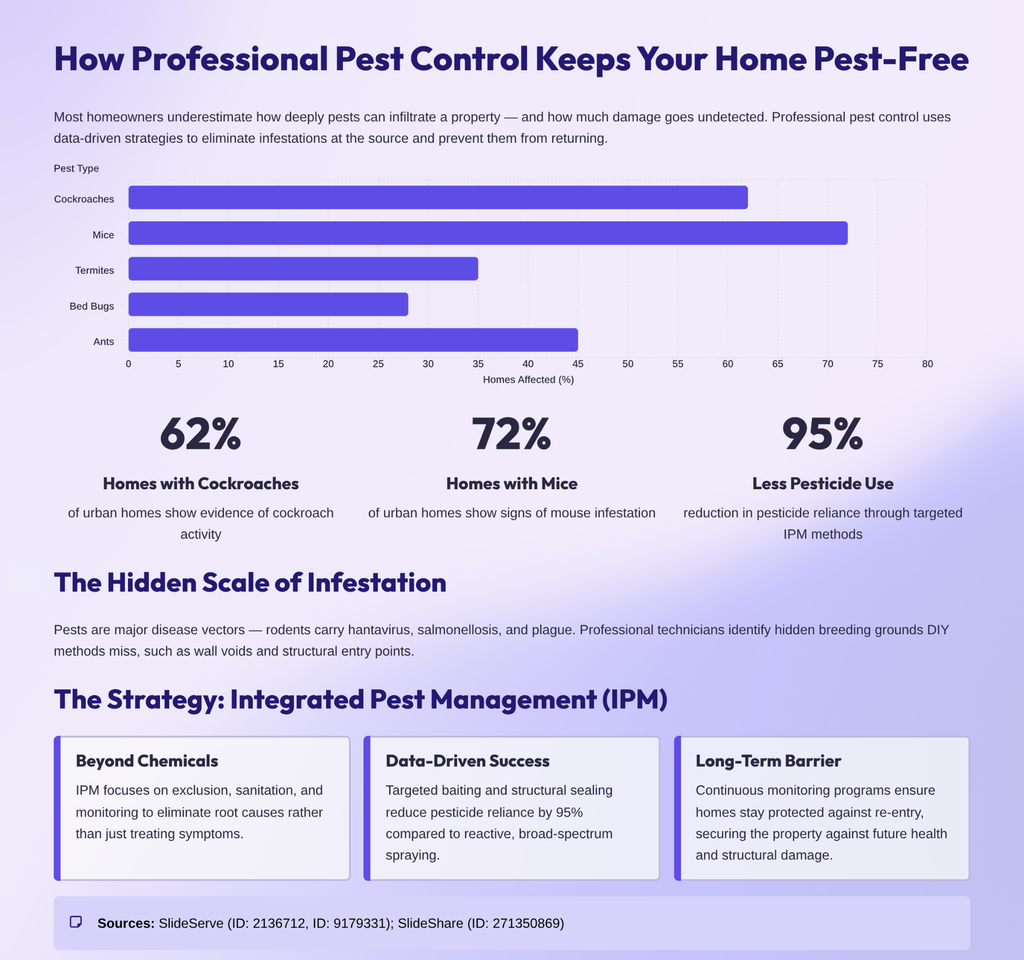
How Professional Pest Control Keeps Your Home Pest-Free
The Hidden Scale of Infestation
- Prevalence in urban environments: 62% of homes show evidence of cockroaches and 72% show signs of mice
- Health impact: Pests are major vectors for disease, with rodent-related threats including hantavirus, salmonellosis, and plague
- The diagnostic edge: Professional technicians identify hidden breeding grounds that DIY methods miss, such as wall voids and structural entry points
The Strategy: Integrated Pest Management (IPM)
- Beyond chemicals: IPM focuses on exclusion, sanitation, and monitoring to eliminate root causes rather than just treating symptoms
- Data-driven success: Targeted baiting and structural sealing reduce pesticide reliance by 95% compared to reactive, broad-spectrum spraying
- Long-term barrier: Continuous monitoring programs ensure homes stay protected against re-entry, securing the property against future health and structural damage
FAQs About Professional Pest Control
1. Can professional pest control prevent pests from coming back?
It can reduce the likelihood of recurring infestations by combining pest treatment with prevention, monitoring, exclusion, sanitation, and environmental improvements.
2. Why is pest identification important before treatment?
Different pests have different behaviors, nesting habits, food sources, and life cycles. Correct identification helps determine the most appropriate management approach.
3. Does professional pest control only treat visible pests?
No. A thorough approach can investigate hidden activity, entry points, nests, breeding areas, and environmental conditions that may be supporting the infestation.
4. What areas of a home should be inspected for pests?
Both indoor and outdoor areas can matter. Kitchens, bathrooms, attics, garages, foundations, rooflines, utility openings, yards, and other potential entry or shelter areas may need attention.
5. What can homeowners do to support professional pest prevention?
Homeowners can reduce food and water sources, repair leaks, seal openings, manage clutter, maintain screens and doors, keep outdoor areas tidy, and address conditions that provide pests with shelter.